
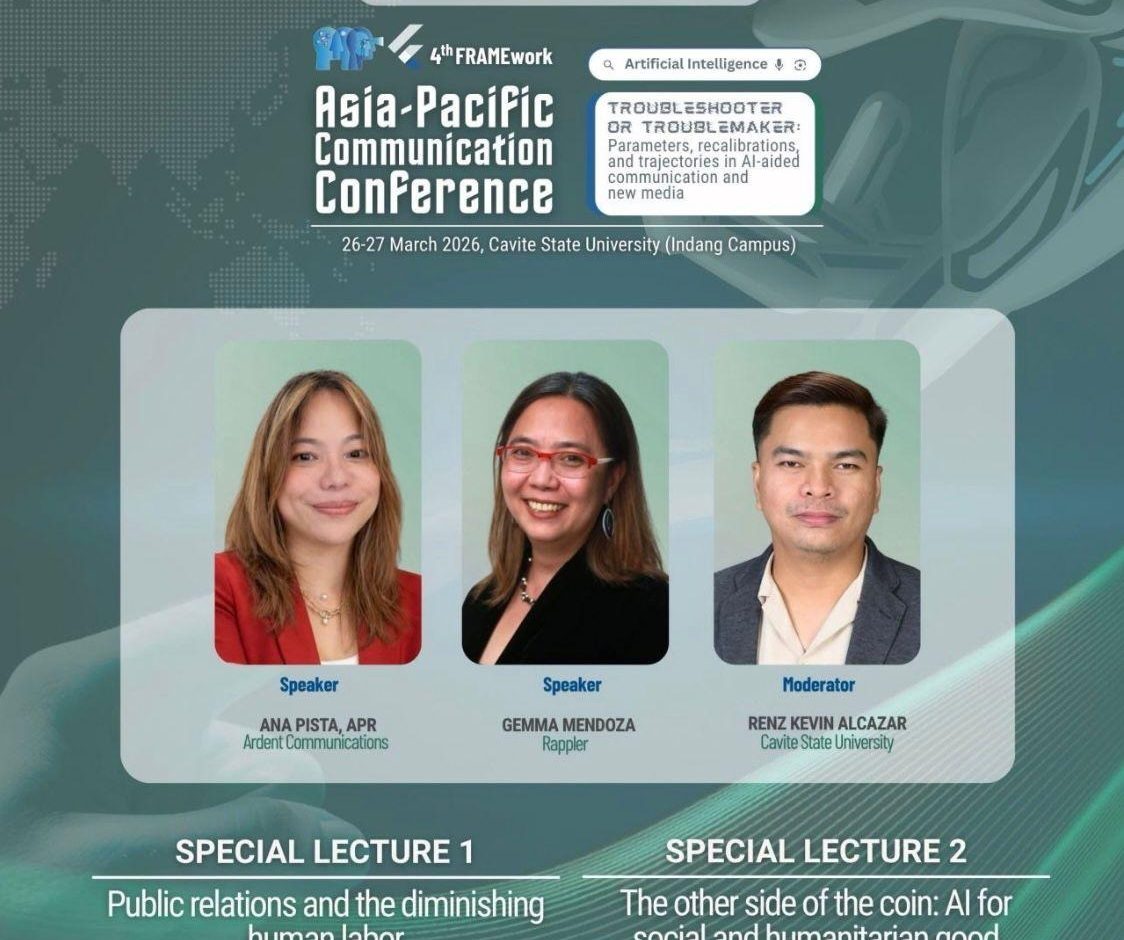
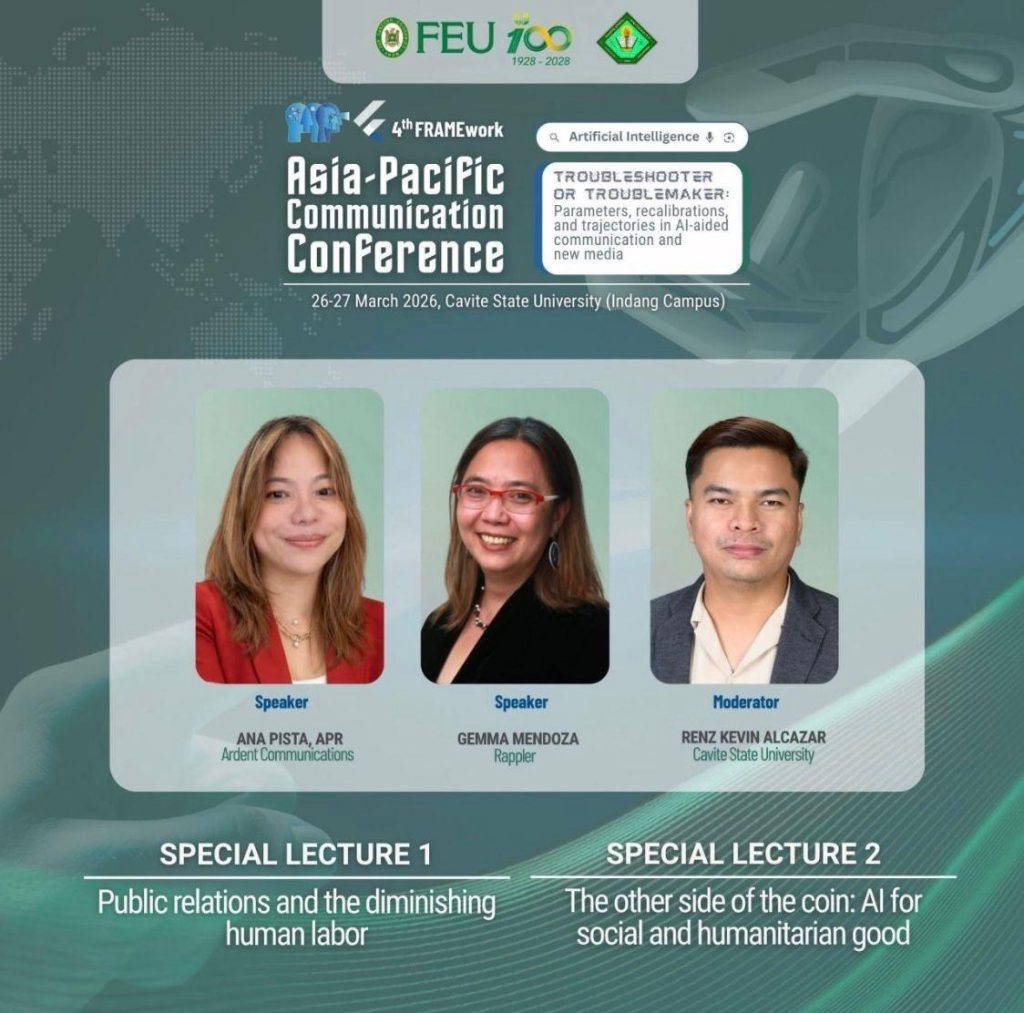
Industry leaders tackle artificial intelligence’s impact on jobs, ethics, and social good
at the 4th FRAMEwork Asia-Pacific Communication Conference.
INDANG, CAVITE — As communications graduates and professionals risk becoming expendable and ill-equipped in an AI-disrupted landscape, industry leaders are calling for urgent job redesignation and curriculum reform at the 4th FRAMEwork: Asia-Pacific Communication Conference on March 26, 2026.
Under the theme “Troubleshooter or Troublemaker: Parameters, Recalibrations, and Trajectories in AI-Aided Communication and New Media,” experts highlighted both the disruptive potential and the strategic opportunities that AI brings to public relations and journalism.
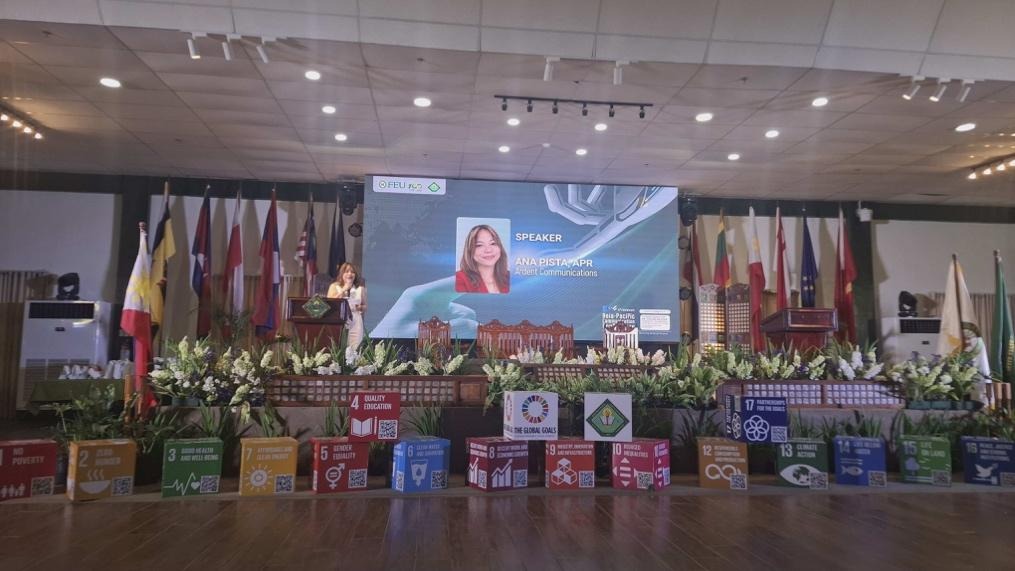
Ana Pista takes the stage at the 4th FRAMEwork Asia-Pacific Communication Conference.
From workforce disruption to redesignation
Ana Ruby Pista, APR, Founder and CEO of Ardent Communications, CEO of the AI Centre of Excellence (ACE), and President of the Public Relations Society of the Philippines, opened the session with her talk, “Public Relations and the Diminishing Human Labor.” She discussed how AI is reshaping the PR profession, framing it as both a challenge and a catalyst for adaptation.
She reflected first on recurring waves of workforce disruption driven by technological advancements.
“It’s a full circle for me—from the launch of Windows 95 that led to workforce disruption, to today with the arrival of AI,” she said.
With the rise of AI, she outlined key shifts in the PR landscape, including the growing preference for answer engine optimization (AEO) over traditional search, the increased use of chatbots for internal communications, and the emergence of “narrative intelligence” for reputation monitoring. These predictions may cut the safety net for PR professionals.
“AI will not replace you. Someone using AI will,” Pista emphasized. For her, this underscores a shift not just in skills, but in how teams are structured for a company to survive.
She shared how her PR agency weathered the storm of workforce disruption.
“At Ardent Communications, we built a quick-reaction team. Our people don’t just report what happened—we predict trends, measure sentiment in real time, and link campaign activity to shifts in brand perception,” she said.
This quick-reaction team is also built around a client’s ecosystem to readily address its needs. As part of this shift, she introduced the concept of a job redesignation; rather than adhering to a rigid job titles and descriptions, individuals should transcend these limitations and employ diverse skills across various communication roles.
“Before, we had job titles. Now, we focus on role-playing,” she said. “The question is no longer what your specific role is—but how you diversify your skill sets.”
Instead of traditional titles like a “PR intern” with fixed duties, she explained that professionals can role-play into multi-skilled contributors—someone who not only writes content as a “PR intern,” but also manages social media, shoots photos, analyzes audience data, experiments with AI tools, and adapts narratives across platforms. By combining these skills into one flexible role, individuals create greater value and can respond to diverse needs.
She concluded with a clear call to action: “AI can never replace us if we upskill, adapt, and lead.”
Gemma Mendoza stresses the importance of companies taking accountability.
AI for good and its risks
Providing a complementary perspective, Gemma Mendoza of Rappler presented “How Can AI Be Used for Social and Humanitarian Good?” She emphasized that while AI offers efficiency and innovation, it must be approached with accountability and a strong human-centered lens.
“I don’t want to say AI is clearly good,” Mendoza said candidly, noting that even news organizations today face challenges such as content scraping, where AI systems reportedly extract and reuse newsroom content without compensation.
At Rappler, she explained, AI is used to enhance journalism through tools such as transcription, summarization, content-to-video formats (TL;DR), and chatbots that help audiences navigate large volumes of information. Rappler is also experimenting with AI to identify patterns across topics, enabling citizens to glean insights for policymakers.
However, Mendoza underscored the risks that come with these innovations, including misinformation, manipulation, and overreliance on automated systems, especially with the rise of agentic AI in many organizations.
“The grounding point here that’s needed, before you start anything, is adopting guardrails,” she said.
As part of these safeguards, Rappler has implemented strict AI guidelines.
“With Agentic AI, we have to revise and update our guidelines, and we have to give them ‘absolute resolutions’ to make sure things are grounded,” she added.
She underscored that AI can amplify social good only when organizations implement strict accountability measures and define hard red lines for ethical use.
Moderator Renz Alcazar (left), Ana Pista (center), and Gemma Mendoza (right) discuss the effects of artificial intelligence. Photo courtesy of FEU NewsDotComm.
Bridging the Gap Between Academe and Industry
The panel discussion, moderated by Renz Kevin Alcazar of Cavite State University, explored the urgent need to align academic training with the realities of an AI-disrupted workforce.
Pista pointed out that many communication graduates eventually enter public relations roles despite the lack of dedicated PR programs in many institutions.
“We always say that 99% of what you read—whether in social media, print, or online—is PR-generated,” she said. “So why is PR treated as a ‘unit’ rather than a course?”
She warned that without curriculum reform that includes AI use, graduates may struggle to compete in an increasingly disrupted and competitive industry.
Mendoza echoed this, stressing that journalists today must be equipped not only with storytelling skills but also with the ability to work with technical demands.
“In this day and age, you cannot be a journalist who doesn’t know how to look at technology through a critical lens or handle data,” she noted.
Teachers and students of Cavite State University attend the 4th FRAMEwork Asia-Pacific Communication Conference. Photo courtesy of FEU NewsDotComm.
The discussion also emphasized the importance of AI literacy, particularly the ability to evaluate, use, and question AI tools responsibly.
Both speakers converged on one critical point: AI must remain a tool—never the decision-maker. As AI continues to evolve, the responsibility lies with communicators to ensure that technology is used effectively and ethically.
About the Conference
The 4th FRAMEwork: Asia-Pacific Communication Conference serves as a platform for Asia-Pacific scholars and practitioners to share research and explore emerging frameworks in communication and is organized by the Far Eastern University – Institute of Arts and Sciences in partnership with regional academic and professional institutions, including Atma Jaya Catholic University of Indonesia, University of the Thai Chamber of Commerce, Amity University, University of the Philippines Diliman, University of the Philippines Mindanao, Cavite State University, Visayas State University, University of Science and Technology of Southern Philippines, Don Mariano Marcos Memorial State University, the Philippine Association of Communication Educators, and the Asian Network for Public Opinion Research.
About Ardent Communications
Ardent Communications is the leading PR agency in the IT sector based in the Philippines, specializing in reputation management, corporate communications, public affairs, and integrated communications strategies.