

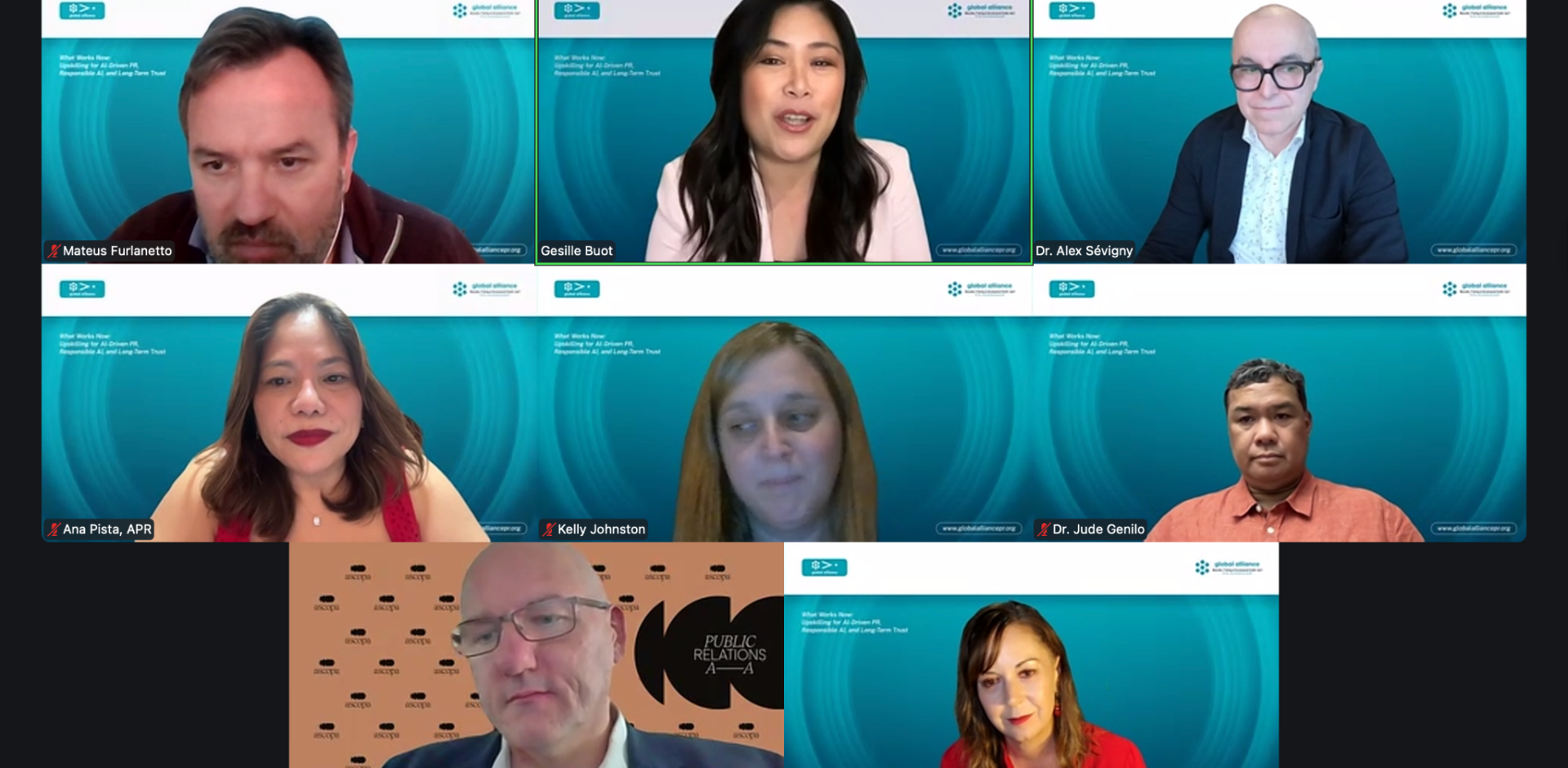
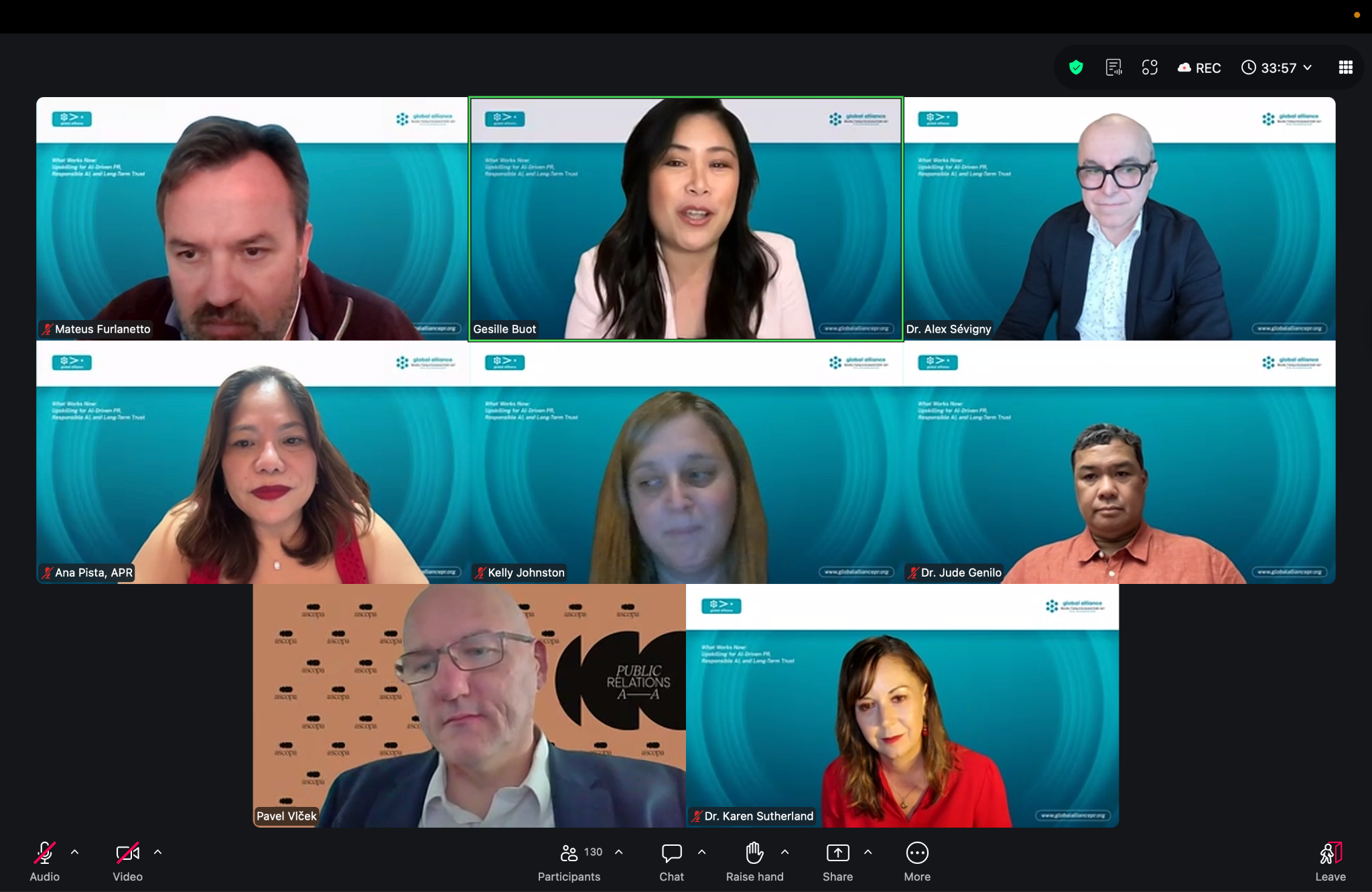
Ana Pista, APR, moderates the Global Alliance’s Cap-Off webinar.
Communications professionals who fail to adapt to AI risk falling behind—not because AI will replace them entirely, but because the industry is being fundamentally restructured around new skills, workflows, and expectations.
This was one of the strongest messages raised during the Global Alliance Education, Training, and Development Month (GAETDM) 2026 Cap-off Webinar, “What Works Now: Upskilling for AI-Driven PR, Responsible AI, and Long-Term Trust,” held on April 30.
The session gathered global communication leaders, educators, and practitioners to discuss the uncomfortable realities reshaping the profession—from AI-driven disruption and workforce shifts to misinformation, governance, and the future of human creativity in public relations.
Moderated by Ana Ruby Pista, APR, the current President of the Public Relations Society of the Philippines (PRSP), the webinar featured insights from Dr. Karen Sutherland, Dr. Alex Sévigny, Pavel Vlček, Dr. Jude William Genilo, and Kelly Johnston.
According to Dr. Karen Sutherland, while 91% of PR professionals already use generative AI daily, only 55% say it is properly integrated into their workflows, revealing a major gap between adoption and strategic implementation.
“Adoption is not the question. Strategic integration is the challenge,” Sutherland explained, warning professionals against blindly relying on AI-generated outputs without understanding accuracy, quality, and misinformation risks.
For Dr. Alex Sévigny, organizations must stop treating AI as a simple productivity tool and start restructuring workflows around it entirely.
“We’ve got to restructure now around the tech,” Sévigny said. “Or we’ll just be automated out of existence.”
The discussion also highlighted growing concerns around trust, governance, and misinformation. Pavel Vlček described AI as a “trust disruptor,” emphasizing that credibility, transparency, and ethical communication are becoming critical strategic priorities globally.
Meanwhile, Dr. Jude William Genilo stressed that communication education must evolve beyond teaching outputs and instead focus on critical thinking, ethics, accountability, and responsible AI use.
The webinar also tackled changing workforce expectations. Kelly Johnston noted that agencies are increasingly seeking AI-native talent capable of combining communication, analytics, research, and digital skills.
Despite AI’s rapid advancement, speakers agreed that deeply human capabilities remain irreplaceable.
“AI may accelerate the work,” Pista said, “but human judgment, cultural understanding, empathy, and trust still define the impact of communication.”
The GAETDM 2026 Cap-off Webinar reaffirmed a growing industry consensus: the future of public relations will belong not to professionals who simply use AI, but to those who can lead, think critically, and build trust alongside it.